Listen To the Audio:
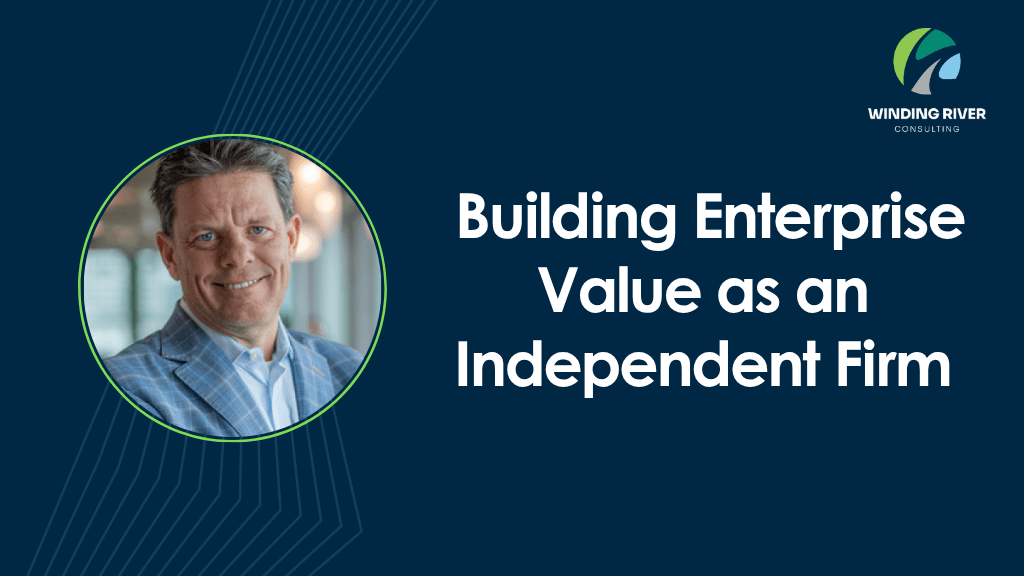
Brian Blaha, CPA, Vice President and Chief Strategy Officer at Winding River Consulting, joins host Rob Brown on the Inside Public Accounting Podcast for a conversation on what it takes for accounting firms to build enterprise value while remaining independent. Below, we've distilled the key takeaways from their conversation.
Independence is a choice, not a default. But what does it actually look like to build lasting enterprise value as an independent firm? The answer requires discipline, intentionality, and a willingness to break some of the models the profession has relied on for decades.
Scale Doesn't Require Massive Size: It Requires Clearing the Next Barrier
When people hear "scale" in the context of accounting firms, they tend to think of billion-dollar PE-backed platforms. But scale happens at every level. A $10 million firm trying to reach $25 million faces many of the same structural challenges as a $50 million firm trying to reach $100 million.
There's a doubling effect in firm growth: at each threshold, the playbook that got you there stops working. The leadership model, the go-to-market approach, the infrastructure; all of it needs to evolve. Firms that recognize these inflection points and invest in what the next stage requires are the ones that break through. The ones that don't tend to plateau, and that plateau is where enterprise value stalls.
This is important because value creation isn't exclusive to the headline PE deals. Firms at every size can build meaningful enterprise value by approaching growth with the same rigor and intentionality that larger, PE-backed firms bring, without necessarily ceding equity to do it.
Performance Gaps Between Firms Come Down to Accountability
The data shows real performance gaps between PE-backed firms and independent firms of similar size. PE-backed firms are often growing faster and adding EBITDA value at a different pace. But that's not because they have access to some secret playbook. It's because they have a stakeholder in the boardroom holding them accountable to strategy markers.
Independent firms have partners they're accountable to, but it doesn't carry the same weight. The discipline that comes from external oversight, whether that's a PE investor or an outside board member, creates a sense of urgency that many independent firms struggle to replicate on their own.
The takeaway for independent firm leaders: you can create that same accountability internally. Whether it's adding outside board members, setting rigorous strategy milestones, or simply holding yourselves to a higher standard of execution, the mechanisms exist. The question is whether the leadership team has the discipline to enforce them.
Governance Is the Foundation, Not an Afterthought
Every conversation about growing enterprise value eventually lands on governance, when really, the conversation should start there. The firms that build the most value are the ones with clear separation between the day-to-day operations of the business and the strategic oversight layer.
The challenge is that when firms first establish a board or governance structure, the partners who serve on it tend to bring their day jobs into the boardroom. A tax practice leader advocates for tax. An audit leader pushes audit priorities. The firm's strategic interests get lost in a tangle of individual practice-level concerns.
It's incumbent on the managing partner or CEO to set the standard: when you enter the boardroom, you're a steward of the firm. Every conversation needs to be evaluated through that lens. Getting this right is foundational. Without it, every other growth initiative will be undermined by misaligned decision-making at the top.
Succession Planning Can't Be Rushed, and Most Firms Start Too Late
Succession is one of the most talked-about topics in the profession, but the conversation often gets reduced to a false binary choice: either you have succession in place, or you sell to PE. The reality is more nuanced.
Firms without a credible succession plan aren't attractive platform investments for PE. Investors need to see a leadership pipeline that can sustain growth over a hold period. And firms that do have succession in place have far more strategic optionality, whether they choose to remain independent, pursue a merger, or eventually accept outside investment on their own terms.
The problem is that building a leadership bench takes three to five years at minimum. Most firms wait too long to start. By the time succession becomes urgent, the window for developing internal leaders has already closed, and the remaining options are limited.
There's also a tension with AI that firm leaders need to think carefully about. As AI strips out entry-level work, the junior talent that would normally develop into your next generation of managers and partners loses the foundational experience that builds their acumen.
Some have floated a "diamond model" for firm staffing, with a concentration of talent in the middle of the organization, and lighter layers at the top and the bottom. But the math doesn't hold up.: if you cut the bottom of the pyramid, you won't have anyone to fill the middle in three to five years. A more sustainable model keeps the foundation intact while using technology to enhance, not replace, the development pathway.
Enterprise Value Modeling Needs to Include the Second Transaction
Firms considering PE investment spend a lot of time modeling the initial transaction — the first unlock of value. Far less attention is paid to what the second transaction looks like, and that's a significant blind spot.
A PE firm typically targets a four-to-five-times multiple on their investment at exit. Achieving that requires a combination of organic growth, inorganic growth through acquisitions, and EBITDA expansion. Firms pull those levers once to deliver the first return. The question nobody's asking is: how do you do it again?
Modeling the second bite of the apple is something every firm considering PE should be doing before they commit to the first. Understanding the full arc gives firm leaders a clearer picture of what they're signing up for and whether the long-term economics actually serve their interests. For many, running those numbers reinforces the case for remaining independent and building value on their own terms.
A Practical Roadmap for Independent Firms
For firm leaders who want to build enterprise value over the next decade while maintaining independence, the roadmap breaks down into three phases.
The first phase is foundational: establish strong governance, align the economics of the firm, and invest in leadership development and succession planning. Partner alignment is critical here, and it's harder than it sounds. Partners bring both a firm-wide view and an individual view, and the managing partner has to navigate both. Even partners closest to retirement can be willing to make concessions if they can see a clear path to the firm's sustainability, but that path has to be articulated and credible.
The second phase is building an organic growth engine: a strategic, proactive go-to-market approach built on the firm's genuine differentiators. Every firm has niches, specializations, or technical capabilities that are underdeveloped. Identifying what the firm can be known for and investing in those areas is where the growth roadmap takes shape.
The third phase is institutionalization: making the firm self-perpetuating through sustained investment in learning and development, career progression, and infrastructure. Technology threads through all three phases as a foundational layer that needs constant attention.
The firms that will thrive are the ones willing to challenge the assumption that "this is the way we've always done it." When that objection comes up, the reframe is simple: what would have to be true in order for us to make this happen? That question opens up possibilities instead of shutting them down.
Building enterprise value as an independent firm isn't passive: it demands the same governance, discipline, and strategic rigor that PE-backed firms operate with. The difference is that independent firms get to do it on their own terms, with their own timeline, and with full ownership of the outcome.
At Winding River Consulting, we work with firm leaders to build the growth strategies, governance structures, and leadership pipelines that drive enterprise value. Whether you're navigating succession, evaluating your strategic options, or building a roadmap for the next decade, our consulting and advisory team can help you chart the path forward. Contact us today to learn more.