Listen To the Audio:
Professional services firms love the language of coaching and mentoring. The terms populate strategy decks, culture statements, and retention plans. Yet despite genuine intentions, many of these programs fail to produce what firms actually need: leaders who are ready, resilient, and committed to the institution.
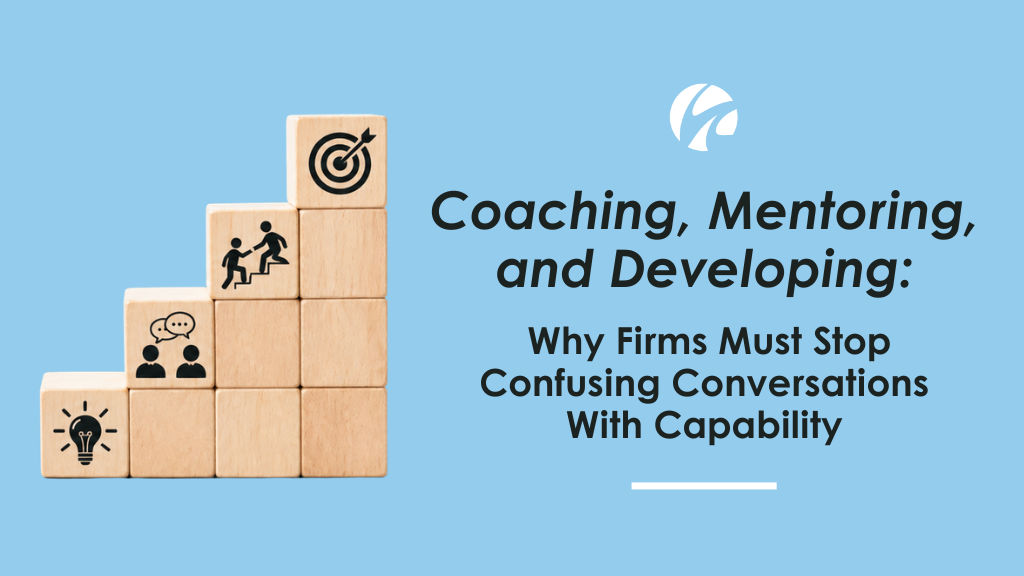
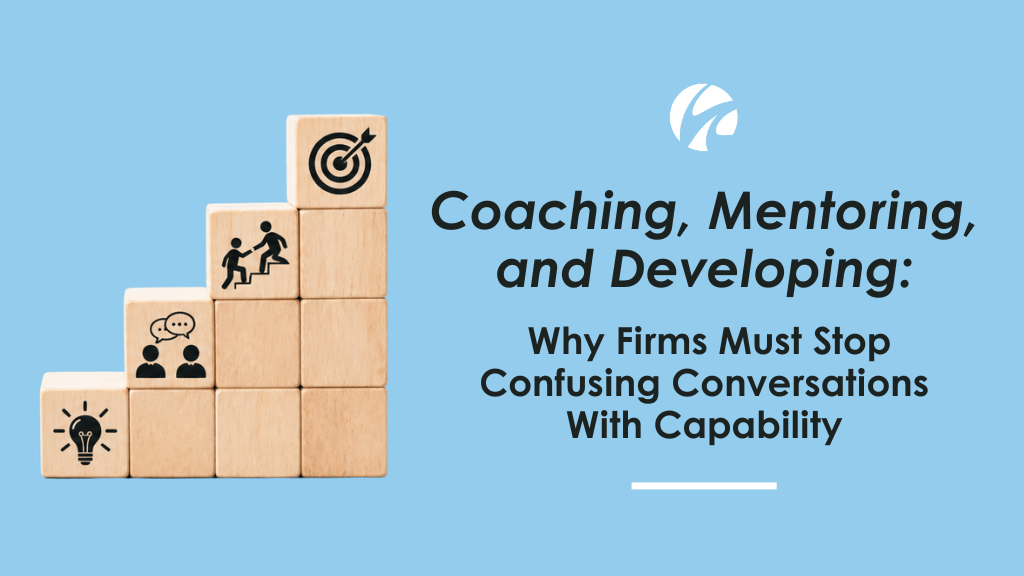
The problem is category confusion. Coaching, mentoring, and developing are distinct activities. Treating them as interchangeable creates programs that feel supportive while producing little long-term leadership capacity.
Three Activities, Three Purposes
Coaching helps individuals generate their own answers. Coaches ask questions, reflect patterns, avoid directing outcomes. The method works well for performance goals, skill refinement, and self-awareness.
Mentoring operates differently. It is relational and experience-based. A mentor shares context, institutional knowledge, and lived experience. Mentoring answers the question "How did this work here?"
Development is something else entirely. Development is a system. It encompasses expectations, exposure, accountability, sequencing, and intentional skill transfer. Development answers the question "Who are we preparing this person to become, and by when?"
Most firms collapse all three into informal check-ins and call the result a program. But building the next generation of firm leaders in an effective way demands a much more nuanced approach.
When Coaching Models Are Misapplied
A growing problem inside firms is the overreliance on coaching frameworks imported wholesale from executive coaching or wellness contexts into internal leadership development roles.
Many coaches are taught explicitly not to advise, direct, or influence decisions such as "Should I stay or go?" or "Is this firm right for me?" Yet these are precisely the questions emerging leaders wrestle with. When internal coaches refuse to engage them, or lack the institutional authority to address them, employees remain unsupported at critical moments. Conversations drift into personal reflection while real career decisions go unaddressed.
This creates risk on both sides. Employees feel seen but not guided. Firms invest time without shaping outcomes. Retention decisions happen without institutional context informing them.
Development requires leaders who can hold both the personal and professional realities of a developing employee, and who possess the training to do so responsibly.
Why Mentoring Alone Falls Short
Mentoring programs often fail for different reasons: they rely on goodwill rather than structure. Senior professionals are asked to "mentor" but receive no clarity on:
- What capabilities they are responsible for building
- How to navigate conversations about performance versus potential
- How to support growth without rescuing or enabling
- When to escalate concerns or redirect career paths
- What leadership capabilities must be built at each career stage
- What business acumen must be transferred rather than assumed
- What decisions developing leaders should begin owning
- What "ready" actually means inside this specific firm
- "Here is what success looks like here"
- "Here is where you are strong, and here is where you are not yet ready"
- "Here is the path, and here is the cost"
- "Here is how I will support you if you choose to pursue it"
Without shared expectations, mentoring becomes uneven and personality-dependent. Some employees receive transformative guidance. Others receive polite encouragement and little else. The inconsistency erodes trust and undermines retention.
Learn More: Mentorship That Actually Works: How to Build a Program People Thrive In
Toward Developer Programs and Modern Apprenticeship
The research behind Train Your SuccessorTM points toward a necessary shift: firms must move from coaching and mentoring programs to Development Programs or intentionally redesigned apprenticeship models.
These programs begin with clarity:
From there, structure matters. Effective development programs include defined expectations and milestones, standard operating procedures for development conversations, shared talking points for leaders, guidance on navigating stay-or-go and role-fit discussions, and training for leaders on integrating empathy with accountability.
This is not scripting authenticity. It is reducing randomness.
Development as Leadership Skill
The primary reason these leadership development programs fail is not lack of interest. It is lack of preparation. Leaders are asked to develop others without being trained to do so. They default to what feels safest: encouragement, reassurance, silence.
Development requires leaders capable of saying:
These are leadership skills. Coaching skills alone will not produce them.
The Retention Payoff
People stay when development feels intentional, honest, and grounded in reality. They leave when support feels vague, inconsistent, or misaligned with their lived experience.
Firms that want sustainable leadership pipelines must stop outsourcing development to conversations and start designing it as intentional infrastructure. While coaching and mentoring have their place, true leadership development requires something more deliberate. The future of the firm depends on getting the distinction right.
Winding River Consulting helps firms design leadership development programs that build capability systematically. Connect with our team to explore what this looks like for your firm.