Listen To the Audio:
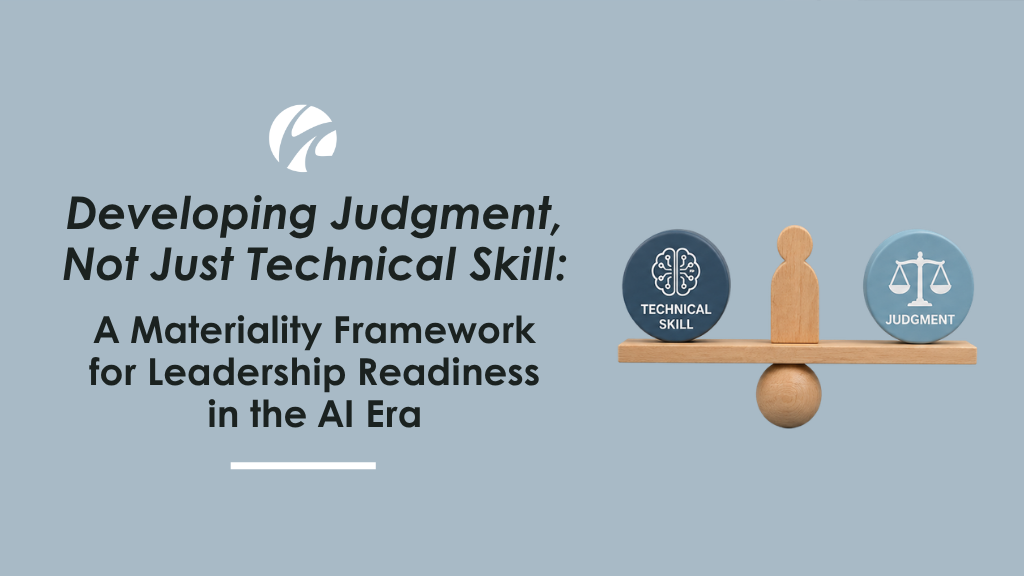
As AI commoditizes technical work, professional services firms are confronting an expensive lesson: knowledge is no longer the differentiator. Judgment is. Firms will distinguish themselves through value-added client service, which depends less on what professionals know and more on what they choose, escalate, prioritize, and own when the answer is unclear.
Research consistently identifies the root issue: leadership development programs have historically over-indexed on technical competence while underbuilding human-centered leadership skills, applied business acumen, and ethical decision-making.
The question becomes: how do we build judgment deliberately?
A practical framework borrows language the accounting profession already respects: materiality. In audit, materiality draws the line between noise and matters. In leadership, judgment is the ability to draw that line quickly, consistently, and with accountability.
The Materiality of Judgment Framework
A repeatable method for building decision-making capability, confidence, and accountability:
1. Define the Decision
Before analysis begins, force clarity. What decision is being made? By when? Who owns it? In firms, ambiguity often serves as a hiding place. "We are discussing it" frequently masks avoidance of ownership.
2. Set a Leadership Materiality Threshold
In audit, materiality concerns what could influence a reasonable user. In leadership, materiality concerns what could harm a client, damage the firm's reputation, break internal trust, create rework, or become expensive later. Teach developing leaders to ask: "If this goes wrong, will anyone care?" If yes, it is material. Slow down, verify, escalate appropriately.
3. Run the Four-Quadrant Scan
Apply an impact-likelihood matrix with leadership-specific implications:
- High Impact, High Likelihood: escalate and involve others early
- High Impact, Low Likelihood: plan safeguards and document rationale
- Low Impact, High Likelihood: standardize through SOPs, checklists, templates
- Low Impact, Low Likelihood: decide fast and move forward
- Monthly Judgment Labs using live client and firm scenarios rather than hypotheticals
- Leader training on how to coach decisions rather than merely review work
- Promotion readiness tied to demonstrated judgment rather than utilization alone
- Protected time for development, addressing the primary barrier leaders cite
This converts intuition into a teachable method.
4. Build Options, Not Answers
Research shows leaders value real-world scenarios because they build confidence and practical thinking. Require developing leaders to generate three viable options: a recommended path, a conservative path, and a creative path. Judgment strengthens through practicing trade-offs rather than pursuing correctness alone.
5. Use AI for Speed, Not Authority
AI functions as a research accelerator. It should feel like cheating, and that is acceptable, provided firms train what comes next: source validation, professional skepticism, client context ownership. Without this training, firms run the risk of amplifying errors at scale and eroding trust.
6. Make the Decision, Then Document the Why
Judgment involves choosing and standing behind the reasoning. Have leaders maintain a brief decision record: what was decided, what was considered, what was ruled out, what would change the conclusion. This creates confidence through traceability while protecting the firm.
7. Debrief to Compound Learning
The fastest path to building judgment is structured reflection. What signals were missed? What mattered more than anticipated? What turned out to be noise? What would be done differently? This aligns with research showing business acumen is assumed but rarely taught; it must be built through time and practice in critical thinking.
Operationalizing Judgment Development
Transform this framework into a Judgment Apprenticeship:
AI will make information cheap. The firms that win will make judgment trainable and visible.
Winding River Consulting partners with firms building leadership development systems that prioritize judgment alongside technical skill. Let's discuss how this framework applies to your firm.